
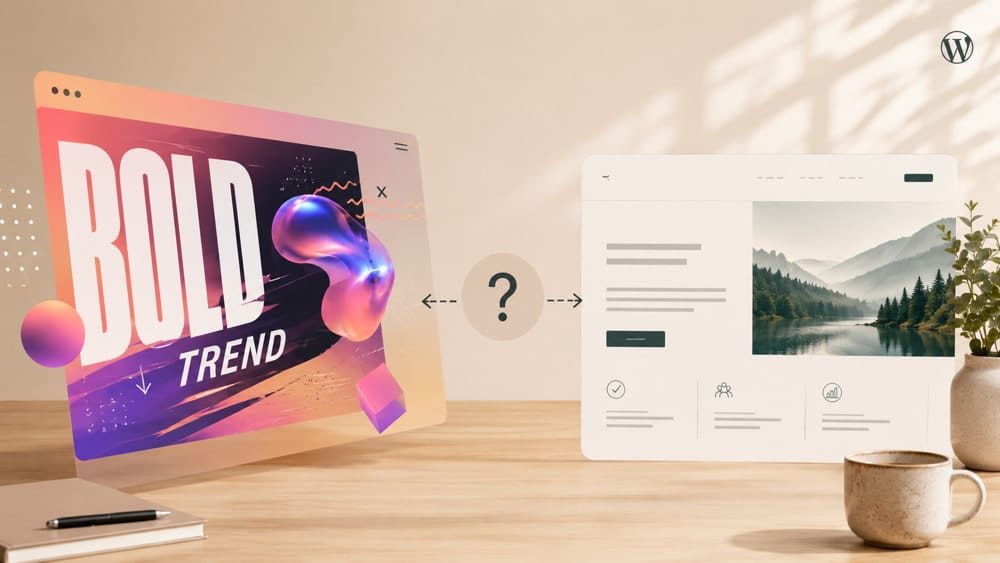
Last month, a client sent me a link. It was a competitor’s redesigned site with huge, oversized headlines, text that animates on scroll, and a layout that ignores the grid entirely. “Can we do this?”
We could. The question is whether they should.
What’s actually trending right now
Oversized type, layered fonts, and anti-grid layouts have been all the rage in WordPress design roundups this year. Sites are also becoming more adaptive, displaying different content or calls to action based on whether a visitor is new or returning.
This looks great in a portfolio. Much of this comes from agencies that build for funded startups and brands with design teams to maintain their sites.
Why it doesn’t fit most SME sites
None of this is incorrect. It’s just designed for a different type of business than the ones I usually work with.
An anti-grid layout takes longer to build because each section is custom-made, rather than part of a repeatable pattern. That’s fine if you have a designer on hand who can make continuous adjustments. However, it becomes problematic when the site needs to outlive the person who built it and someone else has to guess the logic behind every offset and overlap.
Adaptive content sounds appealing until you ask who will maintain the rules. Having different content for first-time versus returning visitors means someone has to decide what those segments see, monitor its effectiveness, and make adjustments. For a five-person company that hasn’t hired a marketer, that’s a feature that no one will look at again after launch.
I had a client who wanted oversized, animated headlines on every page of their site after seeing them on a much larger competitor’s site. Instead, we built one version on the homepage, where there was room to make an impression, and we kept the rest of the site straightforward. The homepage got the attention. The rest of the site stayed fast and easy to update. Doing the full treatment everywhere would have cost more and slowed down every future content change, for a difference that visitors would barely notice past the first page.
Where it does make sense
This isn’t a blanket “no.” There are a few situations in which these trends are worth the cost.
You have a real brand identity to express and someone to maintain it. If a designer or marketing professional is going to oversee the site’s appearance on an ongoing basis, the cost of a custom anti-grid layout is closer to its actual value.
Your homepage does real selling work for a high-ticket product or service. A bold, animated hero section earns its keep when a visitor’s decision to keep reading is worth real money. Local services sites usually don’t have that dynamic.
You’re already using personalization elsewhere and have the data to back it up. Adaptive content makes sense as an extension of what you’re already doing, not as your first step into testing whether visitors care.
If none of these apply, the trend is mostly a cost with no clear return.
What to do instead
Most SME sites derive more value from being fast, clear, and easy to update than from being visually ambitious. A clean layout with one strong typographic choice, clear hierarchy, and good photography is more effective for conversion than an oversized headline that takes three seconds to animate.
To borrow from this trend without the full cost, pick one section, usually the homepage hero, and let it carry the design statement. Keep the rest of the site in a simple, repeatable pattern that the next person managing the site can work with.
What it actually costs
A custom, anti-grid design with unique layouts on every page usually costs between €6,000 and €15,000 for a small business website, depending on the number of pages and the amount of custom interaction involved. A version with a design-forward homepage and a simpler, consistent template for the rest of the site usually costs between €2,500 and €5,000.
The difference isn’t just in the initial build. The fully custom version also incurs higher costs when you want to add a page later because there’s no template to reuse. This ongoing cost is rarely mentioned in the pitch.
A few questions worth asking before you chase a trend
- In a year, who is going to maintain this look?
- Does this design choice affect whether someone buys something, or does it only affect how the site looks in a screenshot?
- If I add a new page in six months, how much extra will it cost to maintain consistency?
If the answers to these questions are unclear, the trend can probably wait.