
Writing code has never been more affordable. A feature that used to take a week can now be completed in an afternoon. I use these tools myself.
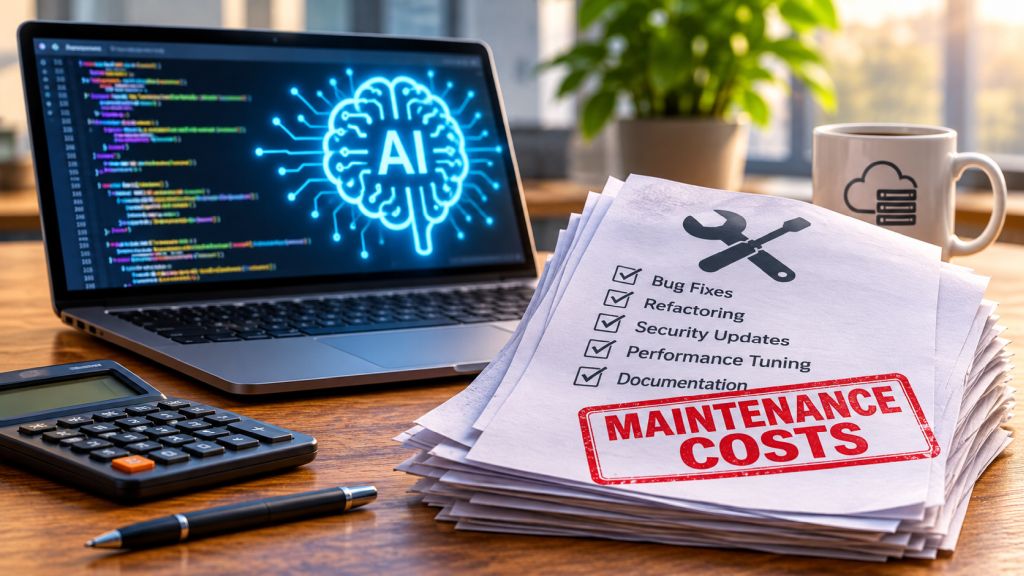
However, code is not a finished product the moment it exists. Someone has to review, test, deploy, understand, and potentially change it later. These costs haven’t decreased along with the cost of coding, and in some cases, they’ve increased. This is a cost that most budgets overlook.
Where the time actually goes
As code writing speeds up, the rest of the pipeline gets more work, not less. More code means more that needs to be reviewed, tested, and deployed, and more that can break in production.
Recent research supports this idea. A 2026 survey by Harness, a vendor of delivery tools, found that teams using AI coding tools several times a day experienced longer average recovery times from production incidents than occasional users: 7.6 hours versus 6.3 hours. However, that survey was conducted by the vendor and was self-reported, so treat it as a signal and not a measurement.
The pattern is easy to understand. A developer who writes faster produces more changes. If the people reviewing and testing those changes don’t also work faster, either the review queue will grow or the reviews will be less thorough. Neither option is free.
What happens to the code itself
GitClear, which analyzes large volumes of changed code, reports record levels of duplicated code blocks, up around 81 percent since 2023, as well as far less refactoring than before. Developers using AI tools seem to accept generated code and move on instead of cleaning up and reusing existing code.
This is important because duplicated code increases future work. For example, when the same logic exists in five places, a bug fix or rule change must be made five times, and someone must remember all five instances.
Consider one more effect. Code that no one on the team wrote is code that no one on the team fully understands. This is fine until it breaks, at which point the cost of understanding it becomes apparent quickly.
Why this lands on small teams
Large companies have reviewers, test engineers, and operations teams. In contrast, a small team often has the same developers writing and maintaining everything with less review.
For a small business that buys software, the risks are different. A system that is quickly built with heavy AI assistance may appear finished but could be costly to modify a year later. You find this out when you ask for a second feature and receive a higher quote than the first.
What I’d do about it
I’m not arguing against using AI to write code. Rather, I’m suggesting that we treat its output as we would a draft from a fast, confident junior developer.
Review everything that ships. Have someone who understands the system read the change before it goes live. Plan for review time as part of the work. As a rule of thumb, review and testing should be budgeted for at least as much as generation.
Insist on automated tests and a pipeline. Tests allow you to safely change AI-written code later. A pipeline that runs tests on every change catches many problems before customers do.
Keep changes small. Large generated changes are hard to review and difficult to undo. Small changes are easier to understand and undo.
Reuse before adding. Ask if the code already exists somewhere in the project before accepting a new copy.
Know who understands each part. If nobody can explain how a component works, there is a risk, even if it works today.
Monitor production, not lines of code. Measure incidents and recovery time. The number of lines written and features shipped are the wrong metrics.
Questions to ask your developer or provider
- Who reviews the AI-assisted code before it goes live?
- Which automated tests cover it?
- Can someone other than the author explain how it works?
- How much would it cost to change this part in six months?
- Are we measuring incidents or only the speed of delivery?
Good answers are specific. If they are vague, that information is useful too.
The honest version
AI tools make code cheaper to produce. However, they do not make software cheaper to own. The savings are real, but only if review, testing, and maintenance keep pace. Those are the parts that don’t show up in a demo.